

When Changing the Body Changes the System
When we speak about the “frequency” of a human being, it is useful to begin with something very concrete.
The human body contains many oscillating systems operating simultaneously and interacting with one another. The heart beats rhythmically, breathing generates another rhythm, blood pressure fluctuates, neural activity produces oscillations across different frequency ranges, while cells, organs and tissues generate electrical, mechanical and biochemical patterns of their own.
The human organism can therefore be understood as an extraordinarily complex network of interacting oscillatory processes rather than as something physically static.
Mass Is Part of the Equation
In physics, the natural frequency of an oscillating mechanical system depends partly upon its mass.
For a simple mass-and-spring system:

where m represents mass and k represents stiffness.
If stiffness remains unchanged, changing the mass changes the natural frequency of the system.
The human body is vastly more complex than a spring and a weight because its mechanical behaviour also depends upon the distribution of mass, tissue composition, elasticity, fluid content, muscular tension, posture and many other factors. Even so, the underlying physical principle remains relevant: when the material characteristics of a system change, its resonant behaviour cannot remain completely identical.
This leads to a simple observation:
if the physical body changes, at least some of its physical frequencies change with it.
Fasting Changes the Physical System
During fasting, the body does much more than become lighter.
Glycogen decreases together with its associated water, sodium and fluid distribution change, adipose tissue is mobilised, body composition changes, hormonal signalling shifts, ketones rise and the metabolic environment is progressively reorganised.
If fasting produces a substantial change in mass and composition, the organism completing the fast is physically different from the organism that began it.
Its mass is different, the distribution of that mass may be different, its fluid content has changed, and many of the tissues participating in its mechanical and metabolic behaviour are operating under different conditions.
It would therefore be physically difficult to imagine that every resonant property of that system remained exactly the same.
The Same Principle Works in Every Direction
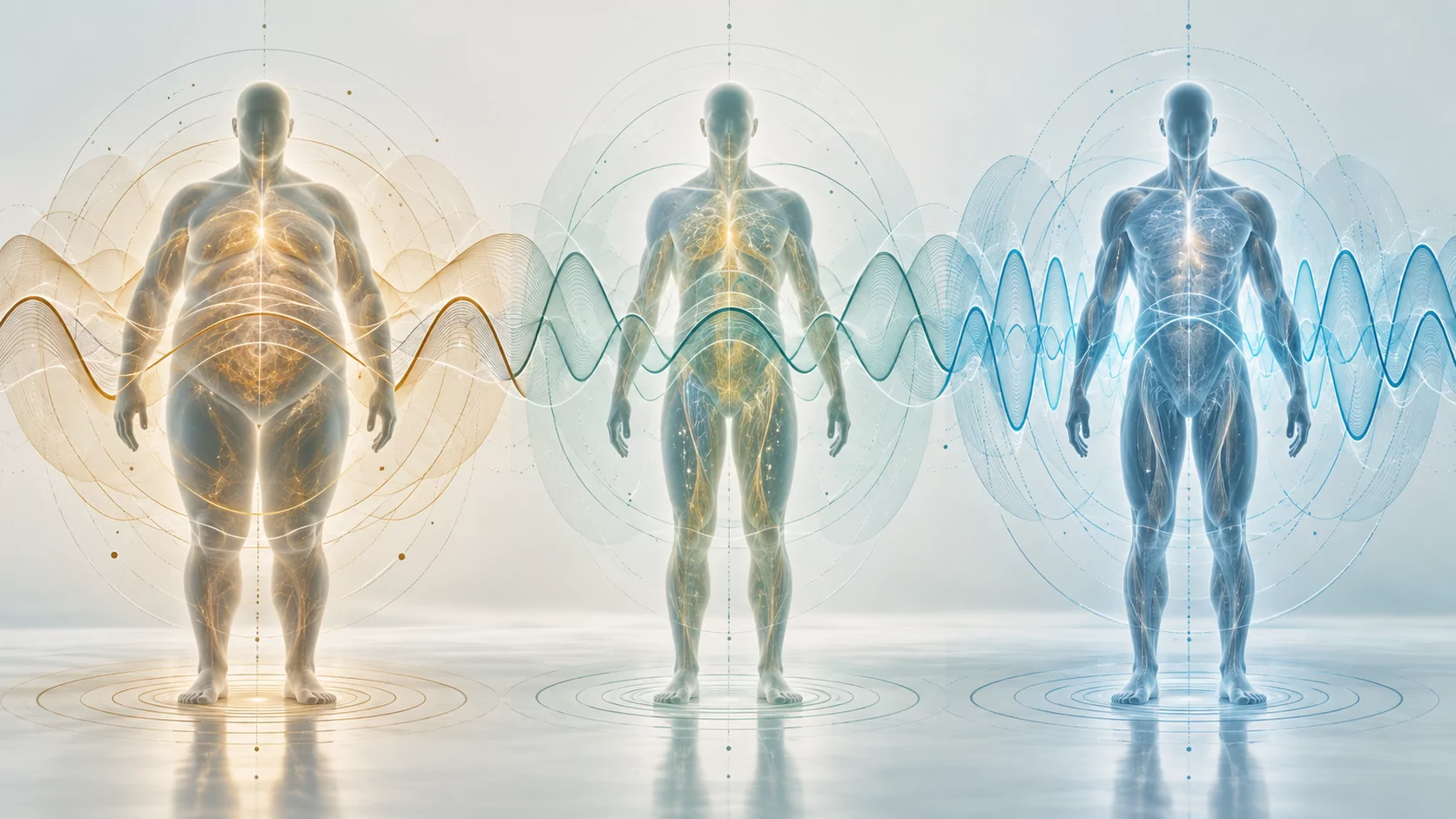 The same reasoning applies when body mass increases.
Gaining adipose tissue changes mass and its distribution. Increasing muscle mass changes the system in another way. Losing muscle, changing hydration, improving mobility, modifying posture or altering connective-tissue tension all change some of the material conditions under which the organism operates.
This is why the question extends well beyond fasting.
Any substantial transformation of the physical body changes the system to some degree, and those changes can influence mechanical, metabolic, neurological and sensory processes simultaneously.
For anyone interested in consciously changing their own state — or, in the broader language used within NHF, their own frequency — the physical body therefore deserves to be considered part of the work rather than merely the container in which the work takes place.
Working on Frequency Means Working on the Whole System
Practices intended to modify one's internal state often concentrate on subtler aspects of experience: meditation, breathing, visualisation, sound, intention, conscious attention or what are broadly described as energetic practices.
All of these may influence the system, yet the system also possesses mass, structure, chemistry and biological history.
If someone attempts to change their internal state while every material condition of their life remains unchanged, they may simply be acting upon a narrower part of the whole.
Changing the body can alter the conditions from which every other practice begins.
This need not involve fasting. A person may lose or gain body mass, develop muscular strength, improve mobility and posture, alter breathing patterns, change sleep and activity, modify the food from which the body is continually rebuilt, or move into a different physical environment.
Each of these changes affects some part of the human system, and the resulting consequences may be mechanical, biochemical, neurological, perceptual, emotional or several of these at once.
Physical transformation and energetic practice can therefore be understood as different ways of acting upon the same complex organism.
Why Fasting Can Produce Such a Strong Shift
Fasting is particularly interesting because it changes many variables at the same time.
Body mass changes, water distribution changes, glycogen is depleted, fat reserves are mobilised, ketones rise, hormonal signalling changes, cellular recycling responds and the brain begins operating in a different metabolic environment.
Sensory perception can also change, together with sleep, appetite, body odour, temperature and the subjective experience of energy.
A person undergoing a substantial fast is therefore physically and metabolically different from the person who began it.
If the way a system oscillates depends upon its material properties, its internal organisation and the relationships among its components, some alteration in its physical frequencies becomes inevitable.
What remains much more difficult to determine is how these measurable changes relate to the broader experiential phenomenon that people may describe as feeling at a different frequency.
That relationship deserves exploration.
The Human Being as an Open System
Trying to reduce a human being to one single frequency may ultimately be less useful than recognising the complexity of the system itself.
Mechanical resonances, electrical activity, biochemical rhythms, circulation, respiration, neural oscillations and molecular motion all coexist, while none of these processes occurs in complete isolation from the surrounding world.
A human being can therefore be understood as an open, dynamic system, continuously exchanging matter, energy and information with the environment.
We breathe air from outside ourselves and return gases to it. We absorb food and water and transform them into living tissue. Light influences biological rhythms. Temperature alters metabolism. Sound physically interacts with the body. Microorganisms, molecules and sensory information constantly pass across the boundary that we ordinarily call “self”.
That boundary remains useful in everyday life, although biologically and physically it is far less absolute than our senses make it appear.
The relevant question therefore becomes broader than identifying the frequency of a person. What matters is that altering any significant part of the system changes the conditions under which the rest of the system interacts.
Environment Is Part of the Equation
The same principle extends beyond the physical body.
A person does not exist independently from place.
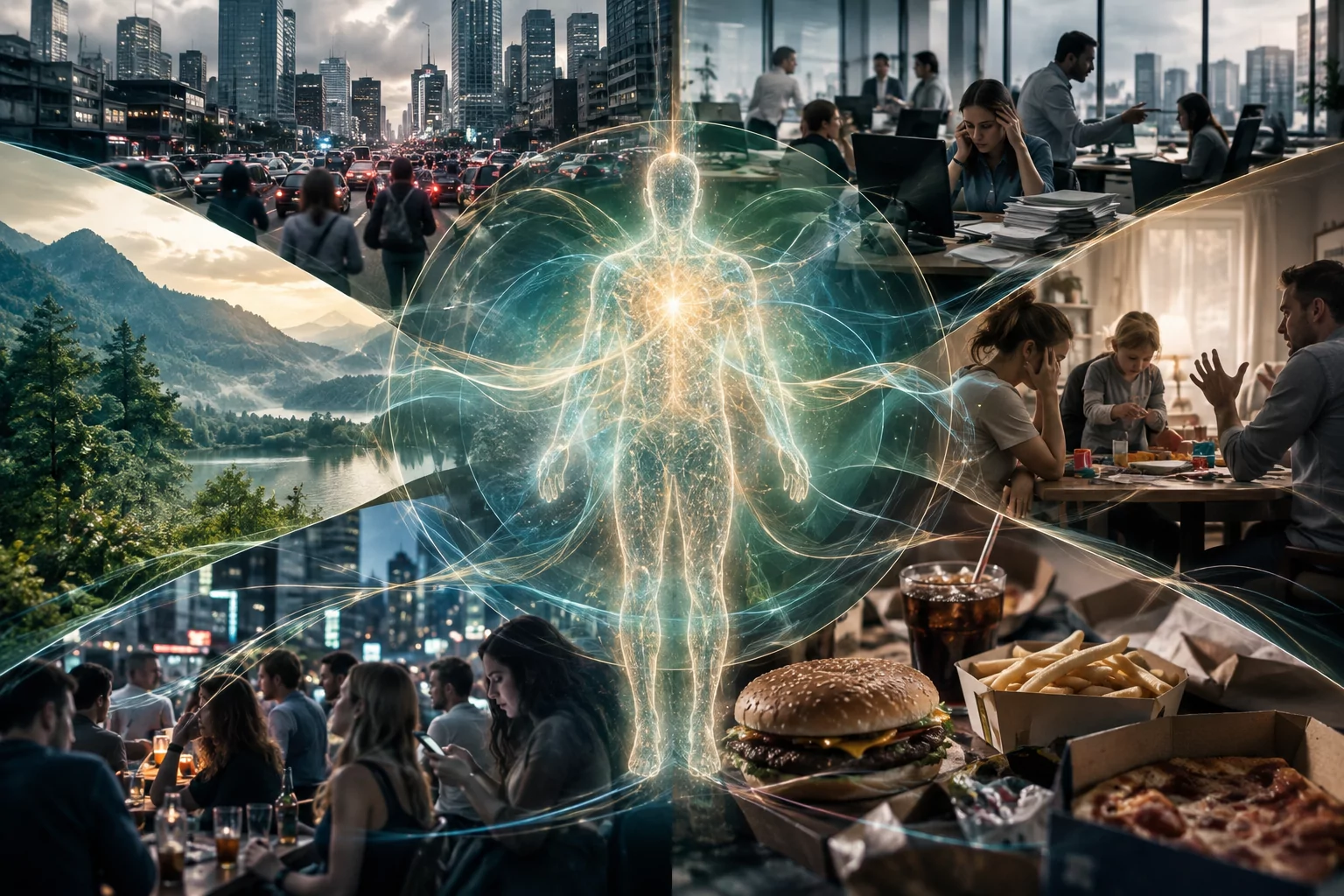
Moving from a noisy city apartment to a forest changes the sensory environment almost immediately: sound spectrum, light, air, temperature, smell, visual complexity and patterns of attention all change. The nervous system responds, breathing may change, muscular tension may change, sleep may change and autonomic and hormonal responses may also change.
The environment therefore participates continuously in the state of the individual.
This is another reason why the idea of a completely self-contained human frequency seems unnecessarily restrictive.
We are always interacting with something larger than ourselves.
Other People Are Part of the Environment Too
The environment in which we live is not made only of air, light, temperature, sound, landscape and physical objects.
It is also made — often to an enormous degree — of other human beings.
Relationships influence us continuously.
A calm person can change the atmosphere of a room. An aggressive person can produce tension before a single word is spoken. Affection, hostility, trust, fear, conflict, expectation and attachment affect breathing, muscular tension, heart rate, attention, hormonal responses and behaviour.
 At the same time, our own state influences the people around us.
The interaction therefore runs in both directions.
If I argue every day with a colleague at work, that relationship becomes part of the environment in which my nervous system and body continuously operate.
If I want to change my state, I may decide to stop fighting with that person. Yet a relationship is created by more than one participant, and changing it may require some change from the other person as well.
Sometimes that happens.
Sometimes it does not.
If the relationship remains chronically conflictual, changing the wider system may ultimately require changing the environment itself — for example, moving to another department, changing workplace or reducing exposure to that relationship.
This does not mean that every uncomfortable relationship should simply be abandoned. It means recognising that persistent human interaction is a biological and experiential input, just as noise, sleep, food and physical surroundings are inputs.
Someone attempting to change their own “frequency” while remaining immersed every day in relationships that continually reproduce the opposite state may therefore encounter considerable resistance.
Changing the System Can Support Energetic Work
This leads to a practical conclusion.
Someone wishing to change their internal state may work through meditation, consciousness, sound, breathing or other energetic practices.
Changing the material and relational conditions of the system can support the same intention from another direction.
Reducing or increasing body mass, developing muscle, altering nutrition, changing posture, sleeping differently, moving the body more, changing the physical environment or modifying the relationships in which one spends everyday life all alter variables within the larger system.
The energetic practice then acts upon a different system from the one that existed before.
This may be one reason profound physical or life changes are so often accompanied by changes in perception, mood, identity and the way a person relates to the surrounding world.
The relationship can operate in both directions: changes in state can influence the body and behaviour, while changes in body, behaviour and environment can alter the state from which we perceive and act.
Changing Frequency Through Matter
From this perspective, working on frequency need not mean working only on what cannot be seen.
- Matter is part of the process.
- Body composition is part of it.
- Nutrition is part of it.
- Movement is part of it.
- The place where we live is part of it, and the people with whom we repeatedly interact are part of it as well.
Every substantial change modifies some aspect of the system and therefore changes the conditions under which its countless rhythms, signals and interactions occur.
For this reason, someone who wishes to create a profound change may find it easier when several aspects of the system move in the same direction.
Meditation while remaining physically exhausted, chronically inflamed, deprived of sleep and immersed in continuous conflict may still produce effects, although it is acting against a very different background from the same meditation performed by a rested body, in an environment that supports rather than continually disrupts the desired state.
The point is not to prescribe one ideal condition.
It is to recognise that everything participates.
Fasting as a Change of State
Fasting offers an unusually clear example because the transformation can be rapid and systemic.
Within a relatively short period, the organism changes fuel, chemistry, mass, signalling, sensory experience and patterns of internal resource use.
From the narrowest physical perspective, changed mass and material properties necessarily alter some resonant characteristics of the body.
From the wider perspective adopted by NHF, the question becomes more ambitious:
when so many components of the human system change together, how far does that transformation propagate through the whole being and through its relationships with everything around it?
Perhaps attempting to reduce this question to one numerical “human frequency” would ultimately miss much of what is interesting.
The human being may be better understood as part of a network of interacting processes whose boundaries are less absolute than they appear to our ordinary senses.
What we can already say is simpler and, in my view, more useful:
every profound change in the physical, biological or relational system changes the conditions under which the whole system operates.
For anyone wishing to work consciously on their own frequency, the body, the environment and the people with whom they continually exchange signals and experience therefore belong to the process too.
