

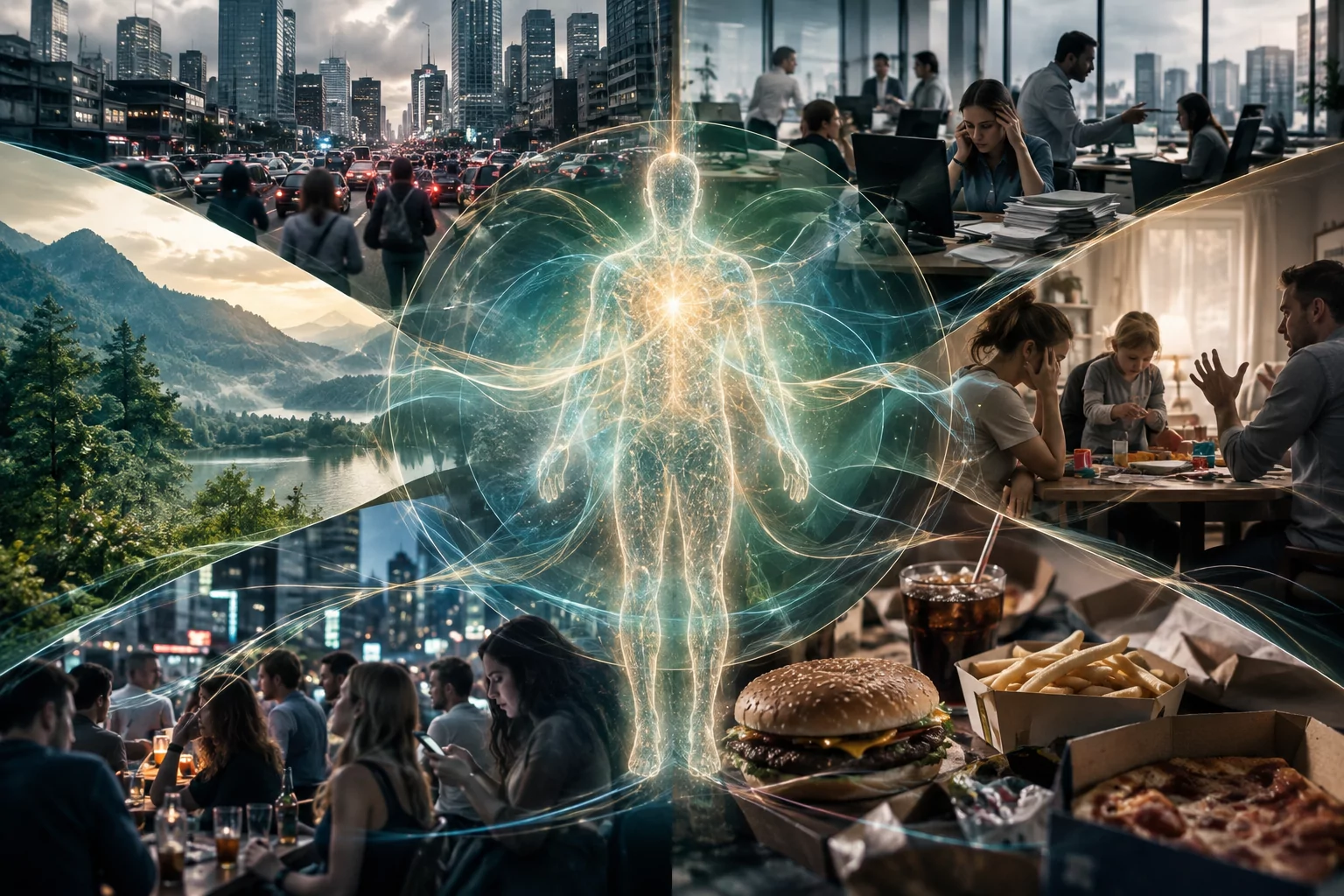
- Details
- Written by: Silvia
- Category: Energy & Awareness
- Read Time: 12 mins
- Hits: 30
When Changing the Body Changes the System
When we speak about the “frequency” of a human being, it is useful to begin with something very concrete.
The human body contains many oscillating systems operating simultaneously and interacting with one another. The heart beats rhythmically, breathing generates another rhythm, blood pressure fluctuates, neural activity produces oscillations across different frequency ranges, while cells, organs and tissues generate electrical, mechanical and biochemical patterns of their own.
The human organism can therefore be understood as an extraordinarily complex network of interacting oscillatory processes rather than as something physically static.
Mass Is Part of the Equation
In physics, the natural frequency of an oscillating mechanical system depends partly upon its mass.
For a simple mass-and-spring system:

where m represents mass and k represents stiffness.
If stiffness remains unchanged, changing the mass changes the natural frequency of the system.
The human body is vastly more complex than a spring and a weight because its mechanical behaviour also depends upon the distribution of mass, tissue composition, elasticity, fluid content, muscular tension, posture and many other factors. Even so, the underlying physical principle remains relevant: when the material characteristics of a system change, its resonant behaviour cannot remain completely identical.
This leads to a simple observation:
if the physical body changes, at least some of its physical frequencies change with it.
Fasting Changes the Physical System
During fasting, the body does much more than become lighter.
Glycogen decreases together with its associated water, sodium and fluid distribution change, adipose tissue is mobilised, body composition changes, hormonal signalling shifts, ketones rise and the metabolic environment is progressively reorganised.
If fasting produces a substantial change in mass and composition, the organism completing the fast is physically different from the organism that began it.
Its mass is different, the distribution of that mass may be different, its fluid content has changed, and many of the tissues participating in its mechanical and metabolic behaviour are operating under different conditions.
It would therefore be physically difficult to imagine that every resonant property of that system remained exactly the same.
The Same Principle Works in Every Direction
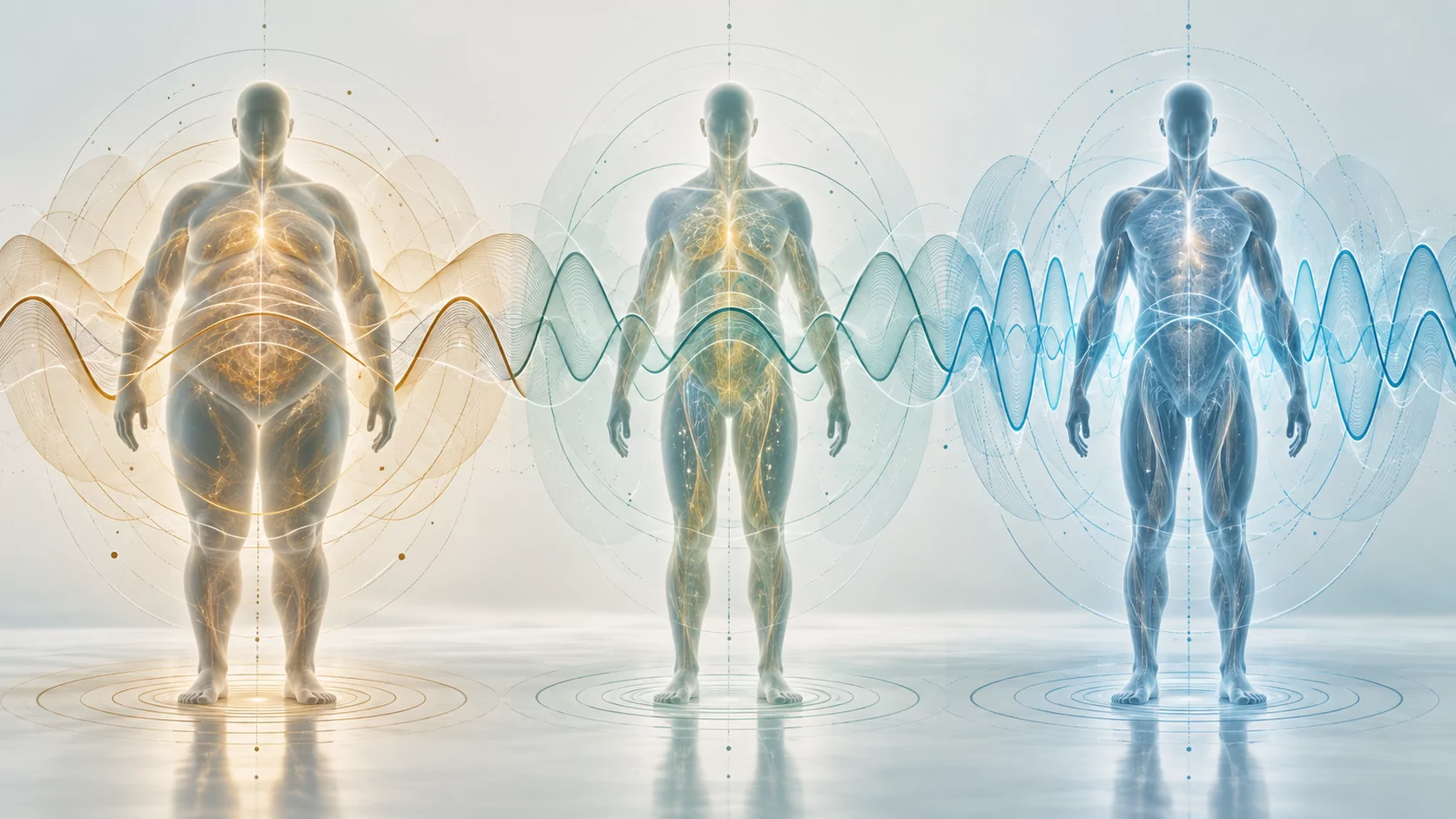 The same reasoning applies when body mass increases.
Gaining adipose tissue changes mass and its distribution. Increasing muscle mass changes the system in another way. Losing muscle, changing hydration, improving mobility, modifying posture or altering connective-tissue tension all change some of the material conditions under which the organism operates.
This is why the question extends well beyond fasting.
Any substantial transformation of the physical body changes the system to some degree, and those changes can influence mechanical, metabolic, neurological and sensory processes simultaneously.
For anyone interested in consciously changing their own state — or, in the broader language used within NHF, their own frequency — the physical body therefore deserves to be considered part of the work rather than merely the container in which the work takes place.
Working on Frequency Means Working on the Whole System
Practices intended to modify one's internal state often concentrate on subtler aspects of experience: meditation, breathing, visualisation, sound, intention, conscious attention or what are broadly described as energetic practices.
All of these may influence the system, yet the system also possesses mass, structure, chemistry and biological history.
If someone attempts to change their internal state while every material condition of their life remains unchanged, they may simply be acting upon a narrower part of the whole.
Changing the body can alter the conditions from which every other practice begins.
This need not involve fasting. A person may lose or gain body mass, develop muscular strength, improve mobility and posture, alter breathing patterns, change sleep and activity, modify the food from which the body is continually rebuilt, or move into a different physical environment.
Each of these changes affects some part of the human system, and the resulting consequences may be mechanical, biochemical, neurological, perceptual, emotional or several of these at once.
Physical transformation and energetic practice can therefore be understood as different ways of acting upon the same complex organism.
Why Fasting Can Produce Such a Strong Shift
Fasting is particularly interesting because it changes many variables at the same time.
Body mass changes, water distribution changes, glycogen is depleted, fat reserves are mobilised, ketones rise, hormonal signalling changes, cellular recycling responds and the brain begins operating in a different metabolic environment.
Sensory perception can also change, together with sleep, appetite, body odour, temperature and the subjective experience of energy.
A person undergoing a substantial fast is therefore physically and metabolically different from the person who began it.
If the way a system oscillates depends upon its material properties, its internal organisation and the relationships among its components, some alteration in its physical frequencies becomes inevitable.
What remains much more difficult to determine is how these measurable changes relate to the broader experiential phenomenon that people may describe as feeling at a different frequency.
That relationship deserves exploration.
The Human Being as an Open System
Trying to reduce a human being to one single frequency may ultimately be less useful than recognising the complexity of the system itself.
Mechanical resonances, electrical activity, biochemical rhythms, circulation, respiration, neural oscillations and molecular motion all coexist, while none of these processes occurs in complete isolation from the surrounding world.
A human being can therefore be understood as an open, dynamic system, continuously exchanging matter, energy and information with the environment.
We breathe air from outside ourselves and return gases to it. We absorb food and water and transform them into living tissue. Light influences biological rhythms. Temperature alters metabolism. Sound physically interacts with the body. Microorganisms, molecules and sensory information constantly pass across the boundary that we ordinarily call “self”.
That boundary remains useful in everyday life, although biologically and physically it is far less absolute than our senses make it appear.
The relevant question therefore becomes broader than identifying the frequency of a person. What matters is that altering any significant part of the system changes the conditions under which the rest of the system interacts.
Environment Is Part of the Equation
The same principle extends beyond the physical body.
A person does not exist independently from place.
Moving from a noisy city apartment to a forest changes the sensory environment almost immediately: sound spectrum, light, air, temperature, smell, visual complexity and patterns of attention all change. The nervous system responds, breathing may change, muscular tension may change, sleep may change and autonomic and hormonal responses may also change.
The environment therefore participates continuously in the state of the individual.
This is another reason why the idea of a completely self-contained human frequency seems unnecessarily restrictive.
We are always interacting with something larger than ourselves.
Other People Are Part of the Environment Too
The environment in which we live is not made only of air, light, temperature, sound, landscape and physical objects.
It is also made — often to an enormous degree — of other human beings.
Relationships influence us continuously.
A calm person can change the atmosphere of a room. An aggressive person can produce tension before a single word is spoken. Affection, hostility, trust, fear, conflict, expectation and attachment affect breathing, muscular tension, heart rate, attention, hormonal responses and behaviour.
 At the same time, our own state influences the people around us.
The interaction therefore runs in both directions.
If I argue every day with a colleague at work, that relationship becomes part of the environment in which my nervous system and body continuously operate.
If I want to change my state, I may decide to stop fighting with that person. Yet a relationship is created by more than one participant, and changing it may require some change from the other person as well.
Sometimes that happens.
Sometimes it does not.
If the relationship remains chronically conflictual, changing the wider system may ultimately require changing the environment itself — for example, moving to another department, changing workplace or reducing exposure to that relationship.
This does not mean that every uncomfortable relationship should simply be abandoned. It means recognising that persistent human interaction is a biological and experiential input, just as noise, sleep, food and physical surroundings are inputs.
Someone attempting to change their own “frequency” while remaining immersed every day in relationships that continually reproduce the opposite state may therefore encounter considerable resistance.
Changing the System Can Support Energetic Work
This leads to a practical conclusion.
Someone wishing to change their internal state may work through meditation, consciousness, sound, breathing or other energetic practices.
Changing the material and relational conditions of the system can support the same intention from another direction.
Reducing or increasing body mass, developing muscle, altering nutrition, changing posture, sleeping differently, moving the body more, changing the physical environment or modifying the relationships in which one spends everyday life all alter variables within the larger system.
The energetic practice then acts upon a different system from the one that existed before.
This may be one reason profound physical or life changes are so often accompanied by changes in perception, mood, identity and the way a person relates to the surrounding world.
The relationship can operate in both directions: changes in state can influence the body and behaviour, while changes in body, behaviour and environment can alter the state from which we perceive and act.
Changing Frequency Through Matter
From this perspective, working on frequency need not mean working only on what cannot be seen.
- Matter is part of the process.
- Body composition is part of it.
- Nutrition is part of it.
- Movement is part of it.
- The place where we live is part of it, and the people with whom we repeatedly interact are part of it as well.
Every substantial change modifies some aspect of the system and therefore changes the conditions under which its countless rhythms, signals and interactions occur.
For this reason, someone who wishes to create a profound change may find it easier when several aspects of the system move in the same direction.
Meditation while remaining physically exhausted, chronically inflamed, deprived of sleep and immersed in continuous conflict may still produce effects, although it is acting against a very different background from the same meditation performed by a rested body, in an environment that supports rather than continually disrupts the desired state.
The point is not to prescribe one ideal condition.
It is to recognise that everything participates.
Fasting as a Change of State
Fasting offers an unusually clear example because the transformation can be rapid and systemic.
Within a relatively short period, the organism changes fuel, chemistry, mass, signalling, sensory experience and patterns of internal resource use.
From the narrowest physical perspective, changed mass and material properties necessarily alter some resonant characteristics of the body.
From the wider perspective adopted by NHF, the question becomes more ambitious:
when so many components of the human system change together, how far does that transformation propagate through the whole being and through its relationships with everything around it?
Perhaps attempting to reduce this question to one numerical “human frequency” would ultimately miss much of what is interesting.
The human being may be better understood as part of a network of interacting processes whose boundaries are less absolute than they appear to our ordinary senses.
What we can already say is simpler and, in my view, more useful:
every profound change in the physical, biological or relational system changes the conditions under which the whole system operates.
For anyone wishing to work consciously on their own frequency, the body, the environment and the people with whom they continually exchange signals and experience therefore belong to the process too.

- Details
- Written by: Silvia
- Category: Energy & Awareness
- Read Time: 4 mins
- Hits: 36
We usually think of sound as something we hear: something invisible, intangible, disappearing as soon as it is produced.
Yet sound is a physical wave. It travels through matter, carries energy and exerts force.
Sometimes that force becomes astonishingly visible.
Sound Can Hold Matter
Water held in mid-air by sound.
In the experiment above, droplets of water remain suspended inside an acoustic field.
Sound waves travelling between an emitter and a reflector form a standing wave. Under the right conditions, the acoustic force becomes sufficient to balance the weight of the droplets and hold them against gravity.
Nothing solid is supporting them.
The sound field is.
An invisible phenomenon is producing an unmistakably physical effect.
Sound Can Deform Matter
At extreme sound-pressure levels, the action of sound becomes impossible to overlook.
Inside this car, powerful low-frequency sound makes the vehicle itself oscillate. The metal body panels move and flex. The seals distort. Even the window glass repeatedly bends to a degree that seems almost incompatible with our idea of glass as a rigid material — and yet it does not break.
Metal appears solid. Glass appears rigid.
Under the action of intense sound, both reveal how dynamic matter actually is.
The most immediate explanation lies in the elastic properties of the materials and in the enormous oscillating pressure acting upon them. Yet watching glass behave almost like plastic inevitably raises a further question:
are we seeing only the mechanical flexibility already present in matter, or can intense oscillatory fields also affect its organisation at deeper levels?
The observation is real. The wider question remains open.
Sound Can Organise Matter

Cymatics: when vibration becomes visible.
Cymatics offers another extraordinary way of observing the relationship between sound and matter.
Particles placed on a vibrating surface rearrange themselves according to the frequency applied. At particular frequencies they gather into remarkably precise geometrical patterns.
Change the frequency and the pattern changes.
What first appears chaotic becomes ordered.
In this case the mechanism can be described physically: the vibrating surface creates standing-wave patterns, and particles migrate towards particular regions of the plate.
But the visual result remains striking.
A different frequency produces a different form.
→ Watch the cymatics experiment on YouTube
Matter Responds to Invisible Fields
Sound is not the only invisible influence capable of producing visible effects in matter.
In the experiment above, highly purified water forms a suspended bridge between two containers under the influence of a strong electric field.
The phenomenon is known as the floating water bridge.
Here the force is electrical rather than acoustic, yet the underlying observation adds another piece to the picture: matter responds to forces and fields that we cannot see directly.
Water changes its behaviour.
Sound can suspend it.
Vibration can organise particles.
Intense acoustic pressure can make metal and glass flex.
An electric field can sustain a bridge of water in open space.
The world that appears solid and static to our senses is, on closer observation, remarkably responsive.
We Are Matter Too
And then there is a question much closer to us.
Our own bodies are matter — living matter, in continuous movement.
Heartbeat, breathing, electrical activity, pressure, chemical exchanges, mechanical vibrations and biological rhythms coexist within us every moment.
We also live immersed in signals and frequencies: voices, music, noise, light, electromagnetic fields, the rhythms of nature and the presence of other living beings.
Some of their effects we perceive immediately.
Others lie outside the direct range of our senses.
And then there is thought.
Thought as a Frequency Selector
A thought can alter the state of the body within seconds.
A frightening idea can accelerate the heartbeat. A memory can change our breathing. Expectation can create muscular tension before anything has physically happened. A few words or a familiar piece of music can transform our internal state almost instantly.
So thought is far from irrelevant to matter.
Within the NHF perspective, we can look at thought as a kind of frequency selector: something that continually influences the state in which we experience ourselves and interact with what surrounds us.
This does not mean that a cymatics experiment proves that thought arranges external matter in geometric patterns.
It suggests a question worth keeping open:
if matter responds so profoundly to fields, forces and vibration, how much remains to be understood about the interaction between living matter, consciousness and the world around it?
Choose Your Frequency
We cannot choose everything that reaches us.
But we can become more aware of what we repeatedly give our attention to: the thoughts we cultivate, the words we use, the sounds we surround ourselves with and the states in which we spend our lives.
Different conditions produce different responses.
Different frequencies produce different patterns.
You can choose what you resonate with.
Observe what happens within you.
Observe what happens around you.
Because something does not have to be visible to have the power to move matter.

- Details
- Written by: Silvia
- Category: Energy & Awareness
- Read Time: 16 mins
- Hits: 32
Between biology, consciousness and the unseen
The pineal gland, or epiphysis, is a tiny structure located deep within the brain. It is well known in medicine for its role in the production of melatonin and in the regulation of biological rhythms, yet for centuries it has also occupied a very different place in philosophy and spiritual traditions.
René Descartes famously associated it with the relationship between mind and body. Eastern traditions have long connected the region with forms of inner perception. Today, the pineal continues to attract researchers interested not only in endocrinology and neuroscience, but also in the still unresolved relationship between brain, consciousness and perception.
One of the most distinctive voices in this field is the Brazilian physician and researcher Sergio Felipe de Oliveira.
In the lectures presented below, de Oliveira moves deliberately between anatomy, neuroscience, physics, clinical observation and spirituality. His purpose is not simply to describe what medicine already knows about the pineal gland. He asks whether some of its anatomical and physical characteristics may help us investigate phenomena that conventional models of consciousness do not yet adequately explain.
To present his work faithfully, it is useful to distinguish between established pineal physiology, observations he reports from his research and clinical practice, and the broader hypotheses through which he interprets them. The distinction allows us to hear his argument in full without confusing an open hypothesis with an already established scientific conclusion.
The biological pineal gland
From a conventional physiological perspective, the pineal is a neuroendocrine organ whose principal hormonal product is melatonin.
Information about environmental light and darkness reaches the pineal indirectly through neural pathways originating in the retina. Melatonin production rises during darkness and forms part of the system through which the body coordinates circadian rhythms and responds to the light–dark cycle.
This alone makes the pineal unusual.
It is a biological structure intimately involved with time: day and night, sleep and waking, rhythmic hormonal signalling and the temporal organisation of the organism.
De Oliveira takes this established characteristic as one of the starting points for a much larger question.
If our physical body occupies space while the pineal continuously helps organise it in relation to time, could this gland represent a particularly interesting interface in the relationship between space, time and consciousness?
What do we actually see and touch?
Before concentrating on the pineal itself, de Oliveira asks his audience to reconsider something apparently much simpler: matter.
When we look at a table, he observes, we do not literally see the matter of the table. We see light reflected from it.
Touch is equally interesting.
At the atomic level, the sensation of two apparently solid surfaces meeting involves electromagnetic interactions between atoms and their electron clouds. Our ordinary sensory experience of solidity is therefore very different from the physical description operating at microscopic scales.
For de Oliveira, this provides an important philosophical lesson.
The reality delivered to consciousness through our senses is already a translation. We perceive an extraordinarily useful representation of our surroundings, rather than necessarily experiencing the fundamental physical nature of things directly.
This question connects naturally with the wider discussion we have already explored at NHF: scientific descriptions of reality have increasingly moved away from the simple picture of a universe composed only of separate, solid objects.
Does the brain produce consciousness?
De Oliveira then turns to one of the largest unresolved questions in science: the origin of consciousness.
He questions the assumption that because damage to a particular region of the brain alters thought, perception or behaviour, consciousness must necessarily originate entirely within that tissue.
His analogy is deliberately simple.
If a television is damaged and the programme disappears from its screen, this proves that the television is necessary to display the programme. It does not, by itself, prove that the programme was created inside the television.
Likewise, he compares the brain to a computer or receiver: an essential biological instrument through which consciousness is expressed, while leaving open the possibility that consciousness itself might not be reducible entirely to the instrument.
De Oliveira therefore regards strict materialism as a philosophical position rather than a scientific conclusion that has already excluded every alternative model of consciousness.
His proposal is not to replace materialism with compulsory spiritual belief. It is to leave the question scientifically open.
The crystals inside the pineal
A central part of de Oliveira's research concerns the mineral structures found within human pineal tissue.
He describes dissecting and examining pineal glands using microscopy and techniques including X-ray analysis, identifying organised mineral structures containing apatite.
Mineral concretions in the human pineal are a recognised anatomical phenomenon, and hydroxyapatite has been identified among their constituents in published scientific studies.
De Oliveira objects, however, to treating all such structures simply as meaningless degeneration caused by age.
In his specimens, he reports finding substantial mineralisation in young as well as older individuals. He therefore prefers to speak of biomineralisation.
His analogy is again very accessible: when teeth develop mineralised structures, we do not say that the mouth has “calcified”. Mineralisation can also form organised biological structures with a function.
He describes pineal crystals showing concentric lamellae, somewhat resembling the rings visible in the cross-section of a tree, and reports differences in their morphology with age.
A biological resonance chamber?
From here, de Oliveira enters the more experimental and speculative part of his model.
He proposes that the mineral structures of the pineal may influence the gland's interaction with electromagnetic fields.
He describes the collection of crystals as potentially behaving somewhat like a resonance chamber, and repeatedly uses the analogy of a mobile telephone or radio receiver.
A radio does not contain the person whose voice comes through the loudspeaker. It receives information conveyed by a physical signal and translates that signal into something perceptible.
Could biological structures operate according to principles that we have not yet fully characterised?
De Oliveira proposes that the pineal may participate in converting electromagnetic information into neurochemical or neural responses. He then extends this possibility further, asking whether certain forms of information associated with thought, emotion, telepathy or spiritual experience might also interact with this system.
This extension remains his hypothesis. It is nevertheless central to his work and to his conception of the pineal gland as an interface rather than merely an endocrine organ.
More than five senses
Another important argument in the lecture concerns sensory perception.
The traditional schoolbook list of sight, hearing, smell, taste and touch is obviously incomplete as a description of human sensory physiology.
The nervous system continuously receives information concerning balance, body position, movement, pressure, temperature, internal physiological conditions and many other variables.
Most of this information never becomes the object of deliberate conscious attention.
De Oliveira uses this fact to make a broader point:
we already know that the organism perceives far more than our conscious mind explicitly notices.
For him, this provides good reason to remain open to the possibility that additional forms of perception may exist or that some experiences currently classified as unusual may eventually acquire better physiological explanations.
Trance, sensitivity and out-of-body experience
A large part of de Oliveira's clinical work concerns states that in Portuguese Spiritist terminology are described as desdobramento — literally an unfolding or separation — and which he associates with out-of-body experience and altered states of consciousness.
He proposes that some individuals enter these states much more readily than others.
In his interpretation, highly sensitive people may become unusually receptive to their surroundings, other people's emotional states and what he calls the psychosphere.
This can create a problem of discrimination:
What am I feeling, and what am I perceiving from somewhere else?
De Oliveira reports that some patients with this pattern become intensely self-critical, anxious, phobic, emotionally exhausted or depressed. He argues that unusual perceptual experiences should therefore be investigated carefully rather than automatically dismissed as meaningless symptoms.
Mediumship and medicine
This leads to one of the most controversial aspects of his work.
De Oliveira studies mediumistic experience as a possible phenomenon with physiological correlates.
He does not describe mediumship simply as a spirit physically entering another human body. Returning to the radio analogy, he proposes a process of reception and interaction: a form of information transfer in which the biological organism acts as the receiver.
According to his model, different patterns of pineal mineralisation may be associated with different kinds of mediumistic or altered-state experience.
He reports examining people in whom pineal crystals were clearly visible on tomography and others in whom they were less prominent, and describes differing patterns of trance or out-of-body experience among them.
These observations form part of his clinical research model; they are not presently an accepted neurological classification of mediumship.
Looking for physical correlates
De Oliveira also presents functional brain imaging and blood-flow observations from individuals experiencing altered or mediumistic states.
He describes examinations showing changes in activity or circulation involving the thalamic and pineal region and, in other cases, other areas associated with perception.
His interpretation is significant.
An imaging change cannot by itself establish what caused an experience or prove that its source is spiritual.
It can, however, demonstrate that an experience dismissed as “only subjective” may coincide with measurable physiological events.
For de Oliveira, that is exactly where scientific investigation should begin rather than end.
Ectoplasm: a proposed bridge
De Oliveira then introduces another concept familiar to the history of psychical and mediumistic research: ectoplasm.
He describes it as a form of energy involved in interaction between consciousness and the physical organism.
His analogy is that air carries sound. In his hypothesis, ectoplasmic energy may provide a medium through which thought or spiritual interaction produces effects in biological systems.
He connects this idea with metabolism and mitochondria, where oxygen participates in cellular energy production, and with the traditional concept of prana, or vital energy.
Within his model, ectoplasm arises from an interaction between biological metabolic energy and a subtler vital component, placing it at the boundary between physical and spiritual processes.
He goes considerably further, suggesting that excessive ectoplasmic production might sometimes be related to bodily phenomena including cysts, mineral deposits, bleeding, weight changes or other physical manifestations.
These are among the most unconventional propositions in his lecture and remain part of his explanatory model, rather than established biomedical conclusions.
Psychiatry, neurology and the danger of premature conclusions
De Oliveira is particularly concerned about patients whose unusual experiences are interpreted exclusively through psychiatric or neurological diagnoses.
He recounts cases involving anxiety, depression, apparent bipolar states, seizure-like episodes and other disturbances in which he believed pronounced mediumistic sensitivity also had to be considered.
One patient he describes had received a long succession of psychiatric treatments before consulting him. Another adolescent had been treated for epileptic episodes which de Oliveira interpreted differently after studying the wider pattern of his experiences.
His argument is not that epilepsy, bipolar disorder or depression are unreal.
It is that similar outward manifestations may conceivably arise through different mechanisms, and that medicine should investigate the person's entire experience before deciding that only one explanatory category is possible.
For obvious reasons, such interpretations should never be used as a reason for somebody to stop neurological or psychiatric treatment without appropriate medical supervision. They are presented here because they form an important part of de Oliveira's research and clinical perspective.
Spiritual experience and psychiatric diagnosis
De Oliveira also calls attention to an important principle already recognised in modern psychiatric assessment: unusual experiences must be understood in their cultural and religious context.
A reported vision, trance state or perceived communication with the dead does not automatically establish a psychotic disorder simply because the experience falls outside the clinician's own worldview.
For de Oliveira, this represents an important opening.
Medicine can study spiritual experience without first being required either to believe it or to deny it.
The phenomenon itself becomes the object of investigation.
Roots before branches
One of the most beautiful analogies in the lecture is that of the tree.
A tree cannot safely develop an enormous crown unless it has strong roots.
De Oliveira applies the same principle to human sensitivity.
A person who is extremely receptive to impressions, emotions, identities or spiritual experiences needs a strong personal centre. Without it, openness can become confusion.
His formulation can be reduced to a remarkably simple idea:
The first spirit you need to receive is yourself.
For de Oliveira, spiritual sensitivity therefore requires grounding rather than escape.
Identity, responsibility, daily life and personal development form the roots. Only then can the crown safely open towards a wider reality.
The pineal gland as an interface
Taken as a whole, Sergio Felipe de Oliveira's model places the pineal gland at several intersecting boundaries.
It is:
- a neuroendocrine structure involved with biological rhythm and melatonin;
- an organ containing organised mineral structures;
- a possible site for studying biological responses to electromagnetic phenomena;
- a structure intimately connected with our biological relationship to time;
- and, in his hypothesis, a possible interface between the physical organism, consciousness and spiritual experience.
This does not mean that every element of the model has already been demonstrated.
De Oliveira's wider message is precisely that scientific investigation should not be limited only to phenomena for which we already possess an explanation.
Nothing becomes real at the moment when science develops an instrument capable of measuring it.
The phenomenon, if it exists, was already there.
The instrument changes what we are able to know about it.
For NHF, this is perhaps the most valuable invitation contained in his work: to preserve the distinction between knowledge and hypothesis while remaining willing to investigate the territory between them.
Watch the original lectures
The two original videos are in Portuguese with Italian subtitles and preserve Professor de Oliveira's complete presentation.
Part 1 — La Ghiandola Pineale – Conferenza del Prof. Sergio Felipe de Oliveira 1/2 – sub ITA
Watch Part 1 on YouTube
Part 2 — La Ghiandola Pineale – Conferenza del Prof. Sergio Felipe de Oliveira 2/2 – sub ITA
Watch Part 2 on YouTube
These Italian-subtitled versions are also listed among the pineal-gland lectures on de Oliveira's official Institute website.
One Reality, Many Levels
What de Oliveira’s conference makes particularly visible is how increasingly difficult it becomes to draw rigid boundaries between the physical, mental and spiritual, or between matter, energy, perception and consciousness.
The divisions are useful. Science and medicine have needed them in order to observe, measure, classify and understand increasingly complex phenomena. Yet the very success of this analytical method may also have encouraged us to think of those divisions as if they existed in reality exactly as they exist in our textbooks.
They may not.
Again and again, research reveals systems that communicate across the boundaries we have created: nervous, endocrine, electromagnetic, psychological, environmental and perceptual processes influence one another continuously. What we describe as separate levels may ultimately be different expressions of a reality whose unity we still struggle to recognise and define.
For centuries, knowledge advanced largely by taking things apart. Perhaps part of the next stage will involve learning how to put them back together.
This requires a different kind of scientific openness.
We do not need to reject what has already been discovered. We need to resist turning present knowledge into an immutable boundary around what can be discovered next.
Phenomena that currently sit between disciplines — or outside accepted explanatory models altogether — may eventually become understandable once we develop better concepts, better instruments and new ways of connecting observations that today remain separate.
At NHF, we believe that each of us can contribute to this process.
We can observe without immediately dismissing. We can compare experiences. We can recognise recurring patterns. We can ask questions that established categories do not yet answer. And we can remain willing to revise our understanding when new evidence appears.
Perhaps physical, mental and spiritual reality are not three different territories.
Perhaps they are three ways of approaching the same territory from where we currently stand.
And perhaps the task ahead is not simply to discover more pieces, but to understand how the pieces belong together.
About Sergio Felipe de Oliveira
Dr Sergio Felipe de Oliveira graduated in Medicine from the University of São Paulo (USP) in 1988 and holds a Master's degree in Sciences from USP's Institute of Biomedical Sciences, with a focus on anatomy, neuroanatomy and cerebral ultrastructure. His Master's research investigated the structure of the human pineal gland using microscopy and related analytical methods.
According to his Institute biography, he has worked in general clinical medicine and has developed research and educational work integrating psychology, psychiatry, biophysics, biology and spirituality. He is Clinical Director of the Instituto Dr. Sérgio Felipe de Oliveira in São Paulo and has been invited to lecture at academic and professional institutions in Brazil and abroad.
His work is particularly associated with the study of the pineal gland and with what he describes as a transdisciplinary investigation of the relationship between brain, mind, body and spirit.

- Details
- Written by: Silvia
- Category: Energy & Awareness
- Read Time: 10 mins
- Hits: 53
What quantum physics tells us — and what may still remain beyond our present understanding
For centuries, the physical world was commonly imagined as something essentially mechanical: solid objects made of smaller solid objects, moving through space according to predictable laws.
Quantum physics changed that picture.
