

How the Body Changes Fuel During Fasting
One of the most important transformations occurring during fasting is the progressive production of ketone bodies.
For many years, ketones were discussed primarily in connection with pathology, particularly diabetic ketoacidosis. Research on prolonged fasting gradually revealed a very different aspect of their biology: ketone production is also a normal physiological adaptation to reduced glucose availability and, during fasting, ketones become an increasingly important fuel for the brain and other tissues.
Ketosis is therefore one of the metabolic adaptations that make prolonged fasting possible. It allows stored fat to become usable in ways that extend far beyond the direct oxidation of fatty acids and changes the metabolic environment of the entire organism.
What Are Ketone Bodies?
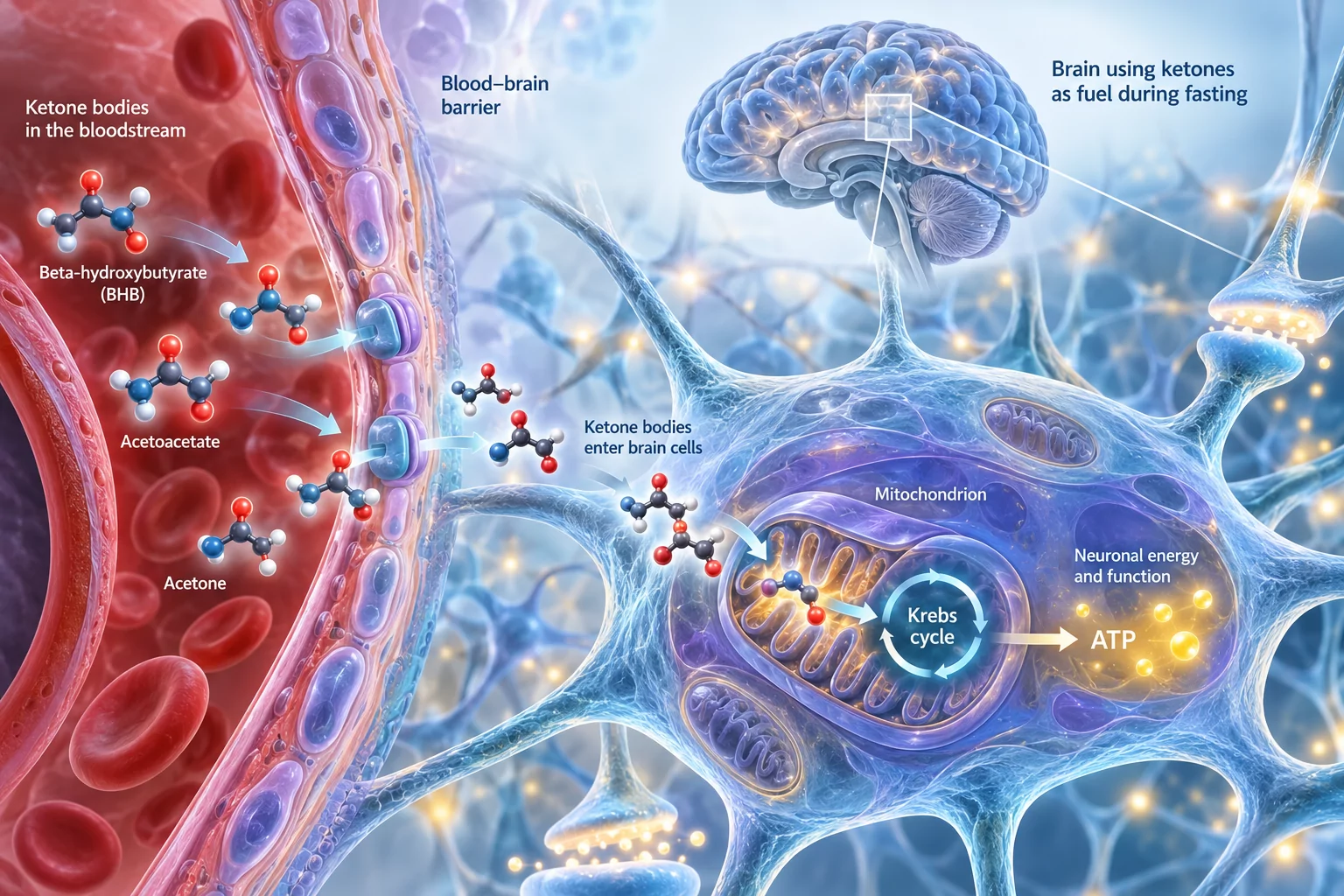
Ketone bodies are small, water-soluble molecules produced mainly by the liver from fatty acids.
The three principal ketone bodies are:
- acetoacetate
- beta-hydroxybutyrate (BHB)
- acetone
Beta-hydroxybutyrate is technically not a ketone from a strictly chemical point of view, although physiologically it is conventionally included in the group.
Their importance becomes clear when we consider a problem the fasting organism has to solve. Human adipose tissue can contain an enormous reserve of energy, yet fatty acids cannot adequately supply every tissue directly, particularly the brain.
The liver therefore converts part of the energy derived from fatty acids into ketone bodies, which circulate easily in the blood and can be used by distant tissues.
In practical terms, ketones provide a transportable form of fat-derived energy.
From Stored Fat to Ketones
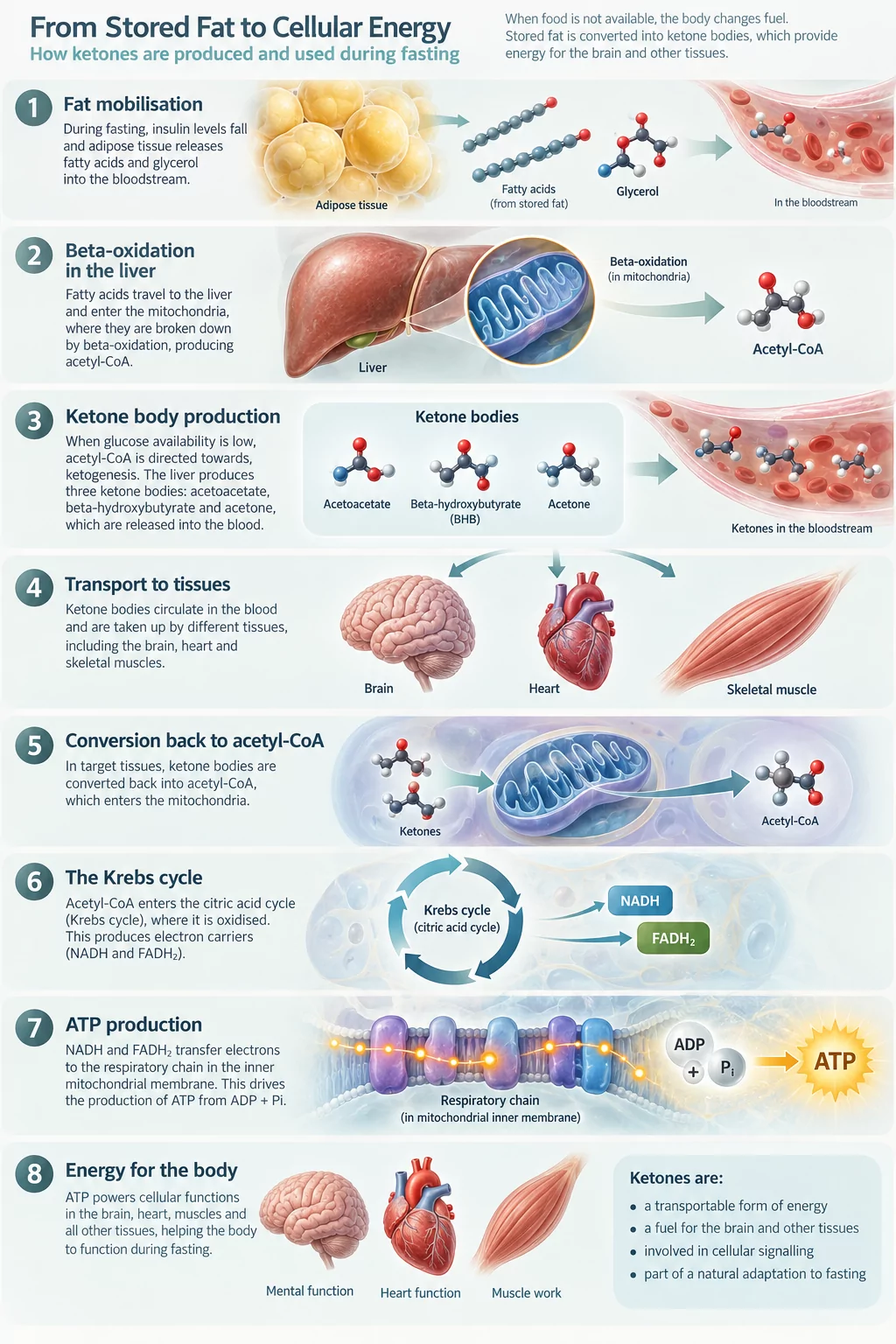 As fasting progresses and insulin levels fall, adipose tissue increasingly releases fatty acids and glycerol into the circulation.
Many tissues can use those fatty acids directly. A substantial portion also reaches the liver, where fatty acids enter the mitochondria and undergo beta-oxidation, generating large quantities of acetyl-CoA.
During fasting, liver metabolism is simultaneously supporting gluconeogenesis. Oxaloacetate is increasingly directed towards the production of glucose, leaving more acetyl-CoA available for ketogenesis.
The liver produces acetoacetate first, from which beta-hydroxybutyrate and acetone are formed.
These molecules are then released into the circulation.
There is a particularly elegant detail in this mechanism: the liver produces ketone bodies for other organs while being unable to use them efficiently itself, because it lacks the enzyme required for their final utilisation.
It effectively manufactures an alternative fuel for the rest of the organism.
Ketosis Develops Progressively
Ketosis has no universal starting hour.
Small quantities of ketones circulate even under ordinary conditions, while their production increases progressively as carbohydrate availability decreases, glycogen reserves fall and fat mobilisation becomes more important.
After several days of complete fasting, ketone concentrations rise markedly. Classic prolonged-fasting studies showed concentrations continuing to increase as fasting progressed, eventually reaching levels of several millimoles per litre while remaining within the physiology of fasting rather than diabetic ketoacidosis.
The speed of this transition varies according to previous diet, physical activity, glycogen reserves, insulin sensitivity and individual metabolism.
Someone who already eats very few carbohydrates may enter substantial ketosis much faster than someone beginning with large glycogen stores and a carbohydrate-rich diet.
For this reason, ketosis is better understood as a metabolic transition than as an event occurring at a particular number of hours.
The Brain Changes Fuel
The brain provides one of the most remarkable examples of human metabolic adaptability.
Under ordinary fed conditions, it depends heavily upon glucose. During prolonged fasting, circulating ketone bodies cross the blood-brain barrier and become progressively more important as cerebral fuel.
As beta-hydroxybutyrate and acetoacetate concentrations increase, the brain adapts its transport systems and metabolic machinery so that these molecules can contribute substantially to ATP production.
The brain continues to require some glucose, yet its dependence on glucose decreases profoundly.
Classic fasting research was crucial in demonstrating how this adaptation allows humans to preserve cerebral function for periods far longer than would otherwise be possible. Without ketone utilisation, maintaining the brain's glucose requirement would demand far greater conversion of body protein into glucose.
Ketosis Helps Preserve Protein
The change in cerebral fuel use therefore affects the whole organism.
During the first phases of fasting, amino acids contribute significantly to gluconeogenesis. As ketones increasingly supply the brain, its glucose requirement falls and the pressure to obtain glucose from body protein can diminish.
This contributes to the protein-sparing adaptation characteristic of prolonged fasting.
Protein metabolism certainly continues. The body does not preserve every gram of lean tissue indefinitely, and amino acids remain part of the metabolic economy.
What changes is the proportion.
Fat becomes the great energy reservoir, while ketosis helps make it possible to protect functionally important protein for considerably longer.
This is one of the reasons the development of ketosis represents such an important boundary between the early stages of food deprivation and the fully adapted fast.
Ketosis and the Disappearance of Hunger
For many people, the most surprising change during fasting is the disappearance of physical hunger.
Before their first fast, people often imagine the opposite: each successive day without food should logically produce an increasingly unbearable demand to eat.
In established fasting, the experience can be radically different.
Once ketosis becomes well established, physical hunger may disappear and the organism enters a remarkably quiet state. Ketogenic conditions have been associated experimentally with altered appetite signalling and reduced hunger, including changes involving ghrelin and other appetite-regulating mechanisms.
From the perspective of fasting physiology, the phenomenon has a clear logic. The organism is no longer dependent upon an imminent external supply of energy because it has gained access to its own large internal reserve.
This distinction between habitual appetite, craving and true physical hunger becomes especially important in prolonged fasting. As discussed in the article on fasting and starvation, the later return of genuine physical hunger is regarded within the Natural Hygiene tradition as the signal that the physiological fast has reached its end.
Acetone: A Metabolic Change We Can Smell
Acetone is unusual among ketone bodies because it is volatile.
A proportion of it leaves the body through the lungs, producing the characteristic breath odour associated with fasting and strong nutritional ketosis.
Breath acetone therefore provides something quite unusual: a metabolic process occurring deep within the liver becomes perceptible through the senses.
Measurements of breath acetone have consequently also been investigated as a non-invasive indication of ketosis and fat metabolism.
The characteristic smell is one of several outward manifestations showing that the chemistry of the body has entered a different state.
Ketones Are Also Signals
Perhaps one of the most important developments in recent ketone research is the recognition that beta-hydroxybutyrate is considerably more than a fuel.
It also behaves as a signalling molecule.
BHB interacts with receptors and regulatory pathways involved in inflammation, cellular stress responses, gene expression and energy sensing. Research has investigated effects involving histone deacetylases, G-protein-coupled receptors, inflammatory signalling and other regulatory systems.
The details are still developing, and biological signalling is far too complex to reduce ketosis to slogans such as “ketones switch inflammation off”.
What matters is the larger principle:
the molecules produced by fasting communicate the metabolic state of fasting to tissues throughout the body.
Ketones therefore carry both energy and information.
A Different Metabolic Message
During prolonged fasting, beta-hydroxybutyrate can increase from very low basal concentrations to millimolar levels.
Every tissue exposed to the circulation consequently encounters a biochemical environment very different from the one present after repeated carbohydrate-rich meals.
- Glucose availability changes.
- Insulin signalling changes.
- Fatty-acid availability changes.
- Ketone concentrations change.
The balance between growth, storage, mobilisation and recycling changes.
Seen in this light, fasting involves far more than calorie deprivation. The biochemical language circulating through the body is different, and cells respond accordingly.
This may ultimately prove to be one of the most important ways of understanding the systemic effects of fasting.
Physiological Ketosis and Ketoacidosis
The association between ketones and diabetic ketoacidosis has historically created considerable confusion.
Physiological fasting ketosis occurs within a regulated metabolic system. Insulin falls but remains sufficient to control excessive lipolysis and ketone production, while acid-base regulation remains intact.
Diabetic ketoacidosis develops when insulin action becomes profoundly inadequate. Ketone production can then become uncontrolled, metabolic acids accumulate and blood pH falls to dangerous levels.
The important variable is therefore the metabolic context rather than the simple presence of ketones.
A person in physiological fasting ketosis and a person experiencing diabetic ketoacidosis may both have circulating ketones while being in radically different physiological conditions.
The Heart and Muscles Also Use Ketones
The brain attracts particular attention because its adaptation is so important to prolonged fasting, although ketone utilisation extends well beyond the nervous system.
The heart is an efficient consumer of ketones, while skeletal muscle can also use them substantially during particular phases of fasting and exercise.
Interestingly, prolonged fasting produces further adaptation. Skeletal muscle increasingly shifts towards direct use of fatty acids, leaving a larger proportion of circulating ketones available for tissues such as the brain. Classic fasting studies observed exactly this redistribution of fuels over time.
Once again, the body follows priorities.
Ketosis is a whole-body state, while different tissues use its fuels differently according to their metabolic requirements.
Mental Clarity and Performance
People living in sustained ketosis frequently describe a characteristic mental clarity, steadier concentration and more stable energy.
This experience deserves attention because it is remarkably recurrent.
Research into ketogenic interventions has found possible cognitive benefits in several contexts, although the quality and quantity of evidence vary considerably. A systematic review found favourable effects in a large proportion of human studies while also noting limitations including small sample sizes and heterogeneous study designs.
The effect on physical performance is more complex.
Fat and ketones can provide an extremely stable energy supply for prolonged lower- and moderate-intensity activity, whereas some forms of repeated high-intensity exercise remain more dependent upon rapid glycolysis and carbohydrate availability.
For this reason, “better performance in ketosis” is unlikely to have a universal meaning.
Yet the subjective experience of having more stable energy and clearer cognition has a plausible metabolic basis and deserves further investigation.
An Evolutionary Question
Ketosis also raises a much broader question about the human diet.
Agriculture is relatively recent in the history of our species. Humans hunted, fished and gathered food long before cultivated cereals, flour and refined sugar became continuously available.
Archaeological and anthropological evidence also shows that meat became increasingly important with the emergence of the genus Homo, although ancestral human diets varied enormously according to geography, climate and season. Modern hunter-gatherer studies demonstrate carbohydrate intakes ranging from very low levels in northern environments to much higher intakes where tubers, fruit, honey and other plant foods are abundant.
There was therefore no single universal “Palaeolithic diet”.
Yet another evolutionary question remains compelling.
Modern humans commonly eat carbohydrate-rich foods several times every day, beginning shortly after waking and continuing until evening. For many people, the metabolism therefore spends very little time in substantial ketosis.
Was that continuous glucose-rich metabolic environment typical during human evolution?
Probably not.
Perhaps the more fundamental human adaptation is metabolic flexibility: the ability to move efficiently between glucose-based and fat/ketone-based metabolism according to food availability.
Modern eating patterns may have reduced how frequently that second metabolic programme is used.

Ketosis and Cancer Metabolism
Cancer introduces another important and controversial dimension.
Many tumour cells display markedly increased glucose uptake and glycolysis, even when oxygen is available. This phenomenon, known as the Warburg effect, has been recognised for approximately a century and remains important enough that glucose uptake is routinely exploited in FDG-PET imaging.
This does not mean that cancer cells live exclusively on glucose. Tumours are metabolically heterogeneous, and some can use glutamine, fatty acids and other fuels.
Nevertheless, the relationship between cancer and glucose metabolism is real.
For this reason, researchers have investigated ketogenic diets and fasting as potential metabolic adjuncts to conventional cancer treatment. Clinical evidence remains developing: recent systematic reviews find interesting changes in glucose and other metabolic variables and some promising signals, while definitive effects on tumour progression, survival and quality of life have not yet been established consistently.
This raises a broader historical question that deserves its own investigation.
The last century has brought an enormous increase in access to refined carbohydrates, sugars, industrial foods and near-continuous eating. Over the same period, many metabolic diseases and several cancers have also become increasingly prominent.
That temporal relationship cannot establish carbohydrate consumption as the single cause of cancer; ageing, smoking, obesity, environmental exposure, hormonal and reproductive factors and many other variables contribute to cancer incidence.
Yet the combination of chronic glucose availability, insulin signalling, metabolic dysfunction and tumour glucose utilisation makes the question too important to dismiss.
We will return to it separately.
What Happens When the Fast Ends?
There is another question I have asked myself for many years.
During prolonged fasting, the organism invests considerable metabolic effort in moving towards fat utilisation and ketosis. The brain adapts, hunger changes, fat becomes the principal reserve and the entire biochemical environment shifts.
Why should refeeding necessarily mean immediately reversing that adaptation through a predominantly carbohydrate-based diet?
Different fasting traditions answer this question differently.
Some contemporary fasting approaches introduce fruit, juices, cereals or other carbohydrate-rich foods early in refeeding. Other traditions, including approaches associated with the Russian fasting school, make considerably greater use of broths, protein foods and fats.
The difference is conceptually important because one approach rapidly moves the organism away from ketosis, while another can allow fat-based metabolism to continue during the transition back to eating.
Whether maintaining some degree of ketosis after fasting is preferable is a question that deserves much more detailed consideration.
My Own Nutritional Journey
My interest in this question is also personal.
For approximately ten years, I followed a vegan and predominantly raw-food diet.
During the first period I felt very well, which reinforced my conviction that I had found an appropriate way of eating. Over time, however, my experience changed. I progressively felt that my body was losing strength and substance rather than gaining them.
Approximately two years ago I changed direction and began following a ketogenic diet containing animal foods and fats.
My experience since then has been very different.
At 56, I feel physically stronger, have substantially more energy and have noticed that my skin is recovering tone rather than continuing the progressive loss of firmness I had previously observed.
This experience has forced me to reconsider convictions I once held very strongly.
It has also made the question of age particularly important to me.
A young organism possesses considerable reserves and regenerative capacity. With advancing age, preserving muscle, connective tissue, bone and physical function becomes increasingly important, and adequate protein assumes greater relevance.
Plant foods certainly contain protein. However, plant and animal proteins differ in amino-acid composition, digestibility and anabolic potential, differences that become especially relevant when protein requirements rise or maintaining muscle becomes more difficult with age. Recent reviews addressing older adults specifically identify protein quality, essential amino acids and digestibility as important considerations when relying heavily on plant proteins.
My experience does not establish a universal diet for everyone, and the much larger question of veganism, natural food, raw food and ketogenic nutrition deserves an article of its own.
It has changed my personal conclusion profoundly.
Today I distinguish very clearly between natural eating, unprocessed eating, raw eating and vegan eating. They are not synonymous, and my experience has given me substantial reason to reconsider the last of them.
We will return to this separately.
Why Ketosis Changes the Experience of Fasting
Ketosis explains many of the characteristics that make a prolonged fast qualitatively different from simply missing several meals.
The organism gains access to its large internal fat reserve, the brain acquires another major fuel, dependence upon protein-derived glucose decreases, hunger changes, and ketone bodies themselves begin participating in metabolic signalling.
The person entering established ketosis is therefore physiologically in a different condition from the person who has merely skipped breakfast.
This explains why experienced fasters often describe a recognisable transition between the initial days of the fast and the period that follows.
The body has changed its metabolic strategy.
A Metabolic State Worth Rediscovering
From an evolutionary perspective, ketogenesis is an extraordinarily useful adaptation.
Human beings evolved in environments where food availability changed continually. An organism with a large energy-demanding brain needed a mechanism that allowed stored fat to support cerebral metabolism during periods without food while preserving vital protein for as long as possible.
Ketones provide that mechanism.
For this reason, describing them merely as an “emergency fuel” seems inadequate.
They are fuel, metabolic regulators and biochemical signals produced by a physiological programme deeply embedded in human biology.
The modern world may have made that programme unfamiliar because food — and particularly carbohydrate-rich food — is continuously available.
Fasting reveals that the programme is still there.
Once glucose from outside stops arriving, the organism remembers how to use it.
Ketosis is one of the principal languages through which the fasting body reorganises itself.
And once we understand that language, a larger question inevitably follows:
should ketosis be regarded only as a temporary state reached during fasting, or as a metabolic condition with a wider place in human nutrition and health?
That question takes us beyond fasting itself — and it deserves an article of its own.
