

What Happens in the Body When Food Stops Coming In
Fasting is not simply the absence of food.
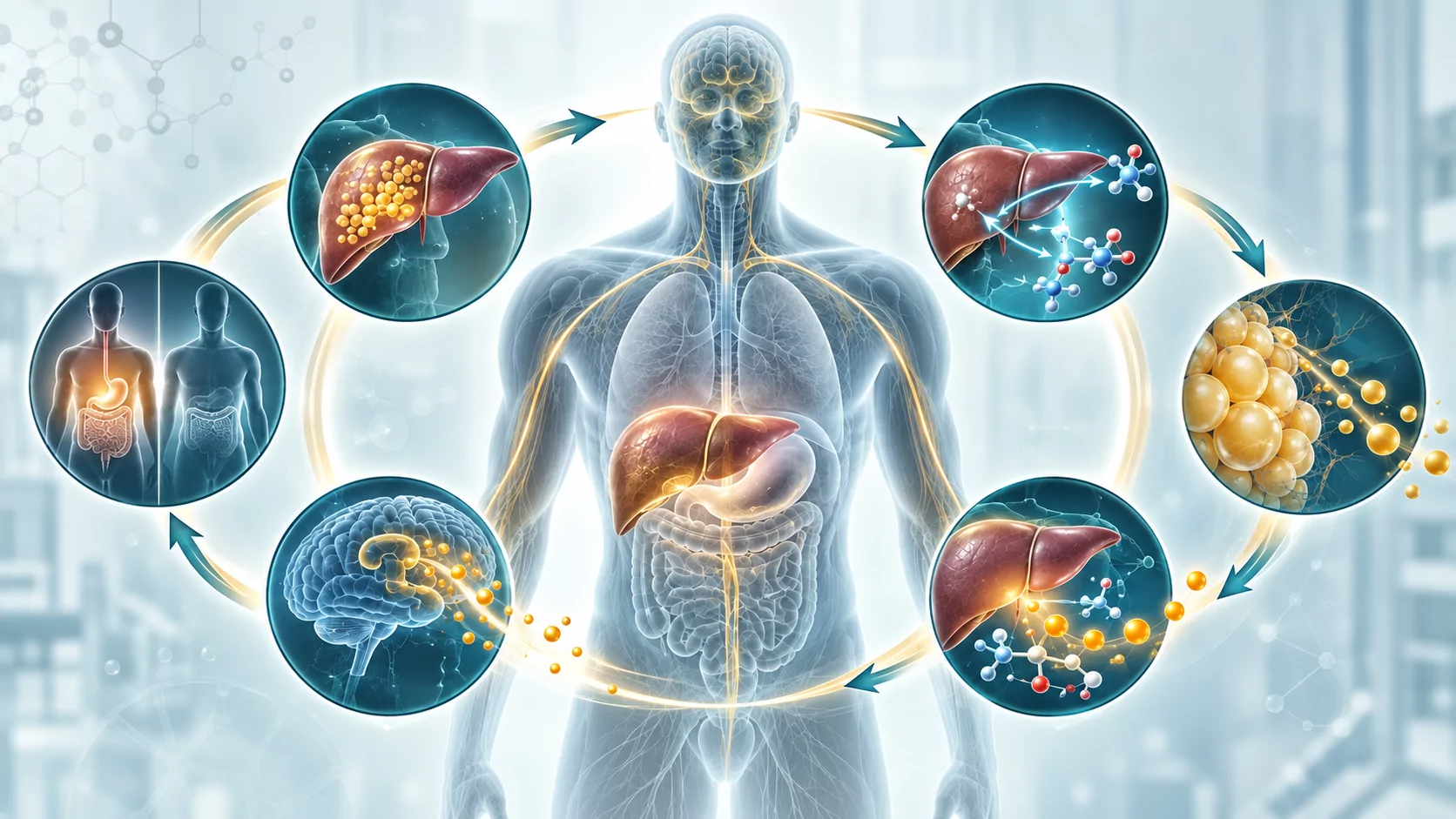
When nutrients stop arriving from outside, the body begins a coordinated metabolic transition.
Hormonal signals change, stored energy is mobilised, different fuels progressively become more important and resources are redistributed according to new priorities.
This transition does not occur at exactly the same speed in everyone. The amount of glycogen stored before fasting, previous diet, physical activity, body composition, metabolic health and previous experience of fasting can all influence the timing.
The stages described below should therefore be understood as a continuum rather than a timetable.
This article refers primarily to fasting in which water remains available. Dry fasting introduces additional physiological mechanisms related to water and electrolyte balance and deserves separate consideration.
From the Fed State to the Fasted State
After a meal, nutrients absorbed from the intestine are readily available.
Blood glucose rises, insulin secretion increases and the body is temporarily in a predominantly anabolic state: energy is being used, stored and incorporated into tissues. Glucose can be stored as glycogen in the liver and muscles, while excess energy can also be stored as fat.
As digestion and absorption come to an end, this situation gradually reverses.
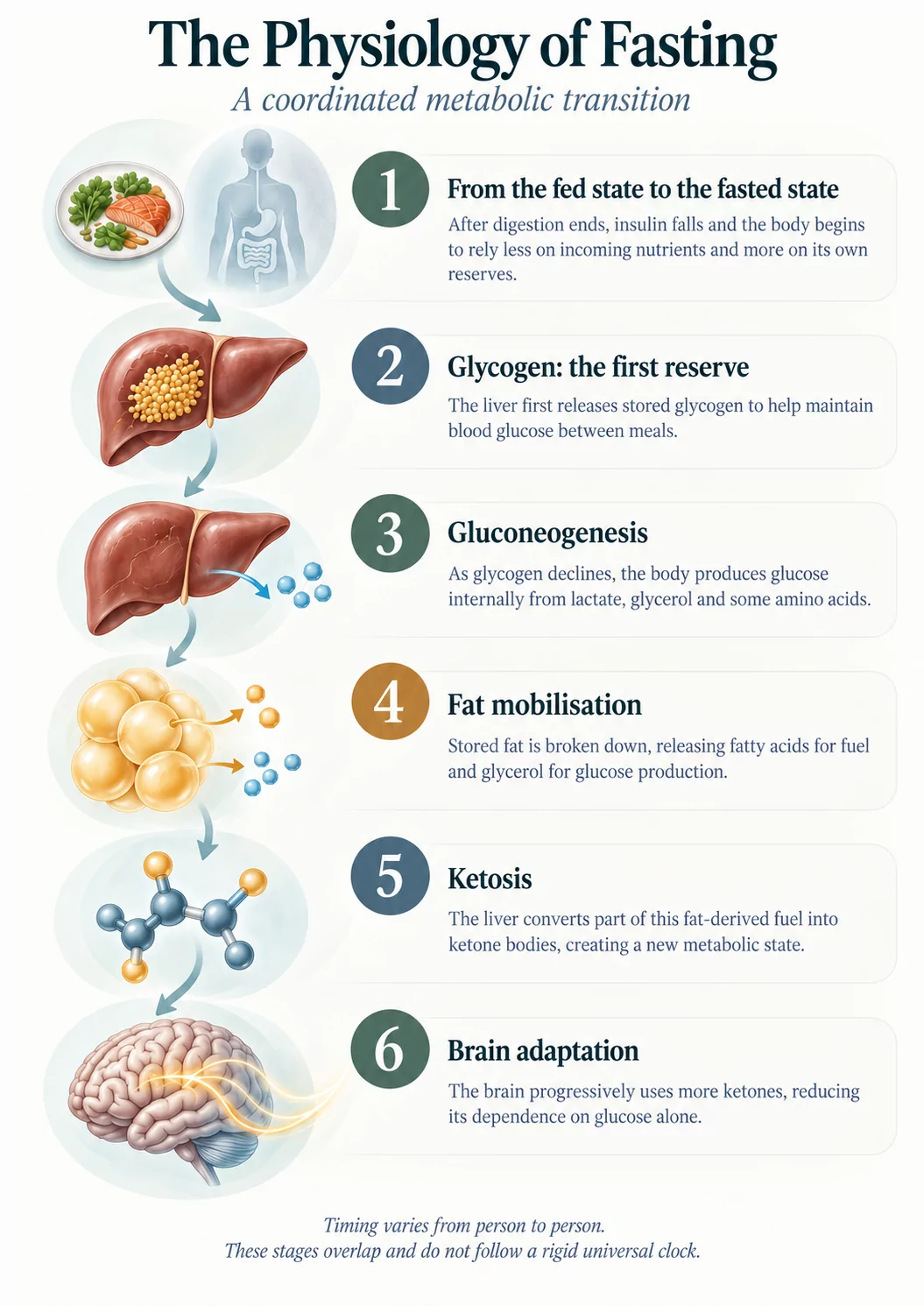
Insulin levels fall and the ratio between glucagon and insulin increases. The body begins to rely less on recently absorbed nutrients and more on its own stored resources.
This transition is sometimes described as the metabolic switch: the gradual movement from predominantly glucose-based metabolism towards increasing use of fatty acids and ketone bodies.
It is not an abrupt event. Fat mobilisation, glucose production and ketone production begin to change progressively and overlap for many hours.
 The First Reserve: Glycogen
The first readily accessible source of glucose is glycogen.
The liver stores glycogen partly to help maintain blood glucose between meals. Muscle also contains substantial glycogen, but muscle glycogen is mainly reserved for use by the muscle itself rather than being released directly into the bloodstream.
During the early fast, the liver breaks down its glycogen through glycogenolysis, releasing glucose into the circulation.
These stores are limited.
By approximately 24 hours of fasting, most hepatic glycogen has usually been mobilised, although the exact timing varies considerably with activity and previous nutrition. At the same time, fatty-acid oxidation is already increasing.
The body does not suddenly run out of energy when glycogen declines.
It changes where that energy comes from.
Making Glucose Without Eating
Some tissues continue to require glucose even when no carbohydrate is being eaten.
The body therefore manufactures it through gluconeogenesis.
The liver is initially the major organ involved, while the kidneys become increasingly important during longer fasting.
The raw materials include lactate, glycerol released from adipose tissue and carbon skeletons derived from certain amino acids.
Gluconeogenesis is already active after an ordinary overnight fast and becomes responsible for an increasing proportion of glucose production as liver glycogen falls. After approximately 48 hours, it can account for the great majority of endogenous glucose production.
This is one reason why blood glucose does not simply fall towards zero when food disappears.
The organism is capable of producing glucose internally.
Fat Takes Over
As insulin falls, stored triglycerides in adipose tissue are broken down.
This process, lipolysis, releases fatty acids and glycerol.
Many tissues can use fatty acids directly as fuel. The glycerol portion can travel to the liver and contribute to gluconeogenesis.
Fat therefore becomes progressively more important as fasting continues.
This transition is crucial because body fat represents a much larger reserve of energy than glycogen.
It also changes what happens in the liver.
As increasing amounts of fatty acids arrive there, they undergo beta-oxidation. Part of the resulting acetyl-CoA is converted into ketone bodies.
These are principally acetoacetate and beta-hydroxybutyrate, together with acetone as a by-product.
Ketone production begins early, becomes much more pronounced during the first few days and can eventually provide a major alternative source of energy.
Ketosis: A Different Metabolic State
The increase in ketone bodies during fasting produces what is known as physiological fasting ketosis.
This must be distinguished from diabetic ketoacidosis, a pathological condition usually involving profound insulin deficiency, uncontrolled ketone production, marked hyperglycaemia and dangerous acid-base disturbance.
In normal fasting physiology, some insulin remains present and ketone production is regulated.
Ketones are particularly important because fatty acids themselves cannot adequately replace glucose as a fuel for the brain. Ketone bodies, however, can cross the blood-brain barrier.
As fasting continues, the brain progressively increases its use of beta-hydroxybutyrate and acetoacetate.
It never becomes completely independent of glucose, but its requirement for glucose falls substantially.
This metabolic adaptation is one of the principal reasons humans can survive periods of food deprivation far longer than would be possible if the brain depended entirely upon glucose derived from glycogen and body protein. Classic human fasting studies were fundamental in establishing this role of ketone bodies.
Protein Sparing: A Change in Priorities
Protein is also used during fasting.
This point is important because fasting does not mean that the body consumes only fat while leaving protein completely untouched.
During the earlier stages, amino acids contribute significantly to gluconeogenesis. Protein breakdown therefore forms part of the adaptation.
As ketone concentrations rise and the brain begins using them more extensively, however, less glucose needs to be produced exclusively for the nervous system. Dependence on amino acids as substrates for gluconeogenesis can consequently decline.
Urinary nitrogen losses tend to fall during prolonged fasting.
This is often described as protein sparing.
The term should not be misunderstood: protein loss does not disappear, and negative nitrogen balance can continue. The precise extent to which protein conservation results from ketone adaptation, falling energy expenditure and other mechanisms remains physiologically complex and has been debated.
The essential point is that prolonged fasting is not equivalent to consuming muscle at a constant rate day after day.
The organism changes its strategy as fasting continues.
The Brain During Fasting
The brain provides perhaps the clearest example of metabolic adaptation.
Under ordinary fed conditions it depends heavily upon glucose.
During prolonged fasting, increasing concentrations of circulating ketones provide another usable fuel.
Studies of prolonged fasting in humans demonstrated that beta-hydroxybutyrate and acetoacetate can eventually supply a substantial proportion of cerebral energy requirements.
Some glucose remains necessary, particularly because certain cells and metabolic pathways cannot replace it completely.
But the reduction in cerebral glucose demand has an important consequence: fewer amino acids need to be converted into glucose simply to sustain the brain.
The nervous system is therefore not metabolically abandoned during fasting.
It adapts.
This is also why old descriptions claiming that nervous tissue is simply “untouched” during starvation are too crude. The meaningful observation behind them is that the organism develops mechanisms that help preserve essential functions while shifting energy increasingly towards fat-derived fuels.
Hormonal Adaptation
Fasting is also an endocrine event.
Insulin falls relatively quickly as nutrient availability decreases. The glucagon-to-insulin ratio rises, favouring glycogen breakdown, gluconeogenesis, lipolysis and ketogenesis.
Growth hormone secretion may increase during fasting, while prolonged fasting can modify thyroid signalling, particularly by reducing circulating active T3. Leptin also falls as energy availability decreases.
Catecholamines, cortisol, the renin-angiotensin-aldosterone system and several other hormonal systems respond in ways that depend on duration, individual physiology and the degree of energy deprivation.
These changes should not be viewed as isolated hormonal effects.
Together they help coordinate the transition from storage and growth towards mobilisation, conservation and adaptation.
Autophagy and Cellular Recycling
Another process frequently associated with fasting is autophagy.
Autophagy is a normal cellular recycling system through which cells degrade and reuse some of their own damaged, unnecessary or dysfunctional components.
It occurs even when we are eating.
Nutrient availability, however, strongly influences signalling pathways involved in autophagy. During fasting, falling insulin and amino-acid availability, reduced mTOR activity and changes in energy-sensing pathways can favour a cellular environment associated with increased recycling and maintenance processes.
This has generated enormous interest in fasting research.
It has also generated considerable exaggeration.
Statements such as “autophagy starts at exactly 18 hours” or “maximum autophagy occurs at 72 hours” cannot currently be applied universally to human beings.
Different tissues may respond differently, and directly measuring autophagic flux in living humans is considerably more difficult than measuring blood glucose or ketones.
The biological principle is well established.
The precise human timetable is not.
Water, Sodium and the First Loss of Weight
The rapid fall in body weight often observed during the beginning of a fast does not represent an equally rapid disappearance of body fat.
Part of it is water.
Glycogen is stored together with water, so glycogen depletion releases associated fluid.
Falling insulin also changes renal sodium handling. During the first phase of fasting, increased sodium excretion — natriuresis — can be accompanied by increased water loss.
Older human fasting studies already observed that the particularly rapid loss of body weight during the first week was largely related to negative sodium and water balance rather than fat loss alone.
With prolonged fasting, hormonal mechanisms involved in conserving sodium and maintaining circulation progressively adjust.
This movement of water and electrolytes is one of the reasons why changes on the scale cannot be interpreted simply as changes in body fat.
A Different Organisation of Metabolism
Seen as a whole, fasting is not a passive condition.
The organism does not simply wait for food to return.
It changes fuel.
It releases stored energy.
It manufactures the glucose that remains necessary.
It increases fat oxidation and ketone production.
The brain alters its choice of fuel.
Hormonal signalling changes.
Water and electrolyte handling changes.
Processes of cellular maintenance and recycling respond to altered nutrient availability.
And, as fasting becomes prolonged, the body continually adjusts how much of its different reserves it can afford to use.
Fasting is not an absence of metabolism. It is a different organisation of metabolism.
When food stops arriving from outside, the organism changes strategy.
